Best Abacus for Teaching Math to Kids (3 Picks That Actually Work)
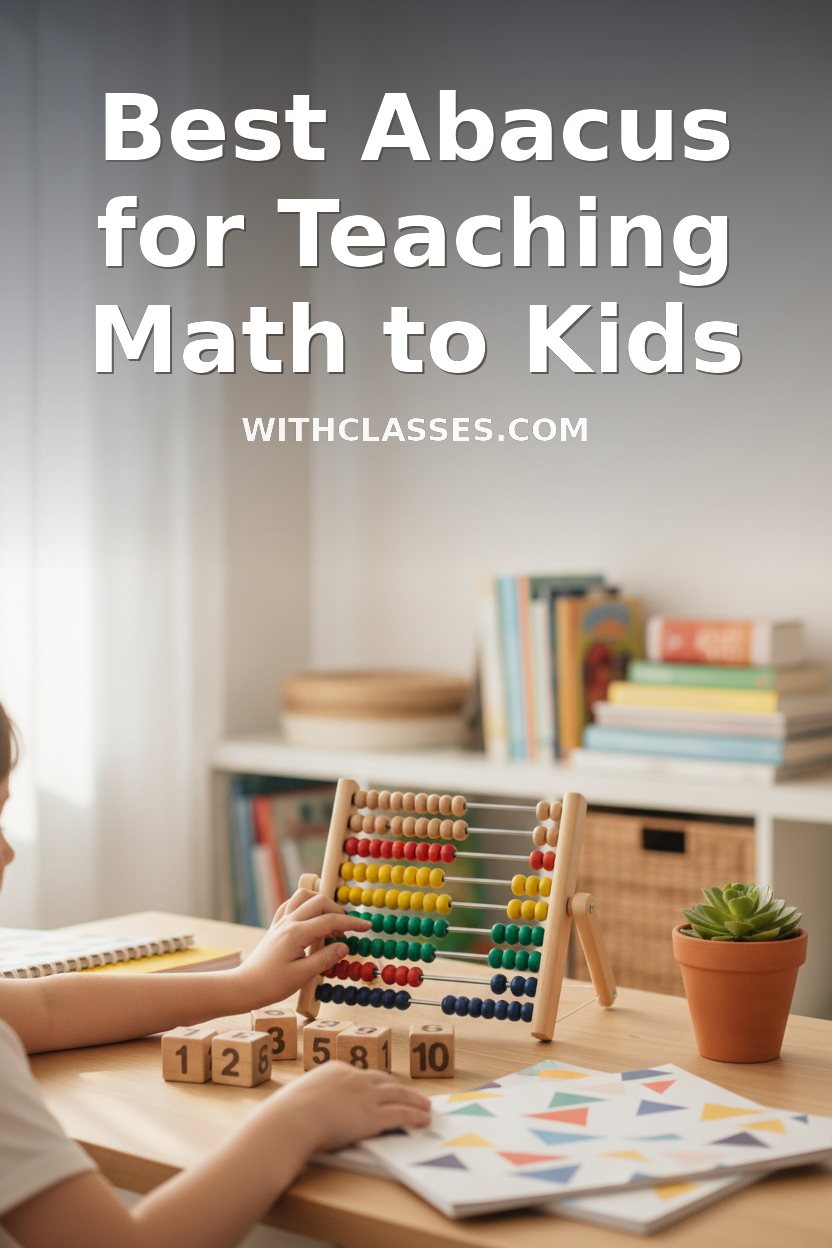
If you just want the answer: the Melissa & Doug Classic Wooden Abacus is our top pick for most homeschool families — it's durable, developmentally appropriate, and it just works. Below we compare three solid options so you can choose the right one for your child's age and learning stage.
1. Melissa & Doug Abacus Classic Wooden Toy — 100 Beads
This is the one I'd hand to a new homeschool parent without hesitation. The frame is solid hardwood, the 100 beads are brightly colored and slide smoothly, and the size is just right for small hands — not so big it's awkward, not so small the beads are fiddly. It's been around forever for a reason.
It covers counting, grouping, addition, subtraction, and even early multiplication — all without needing an instruction manual. It's also tough enough to survive being knocked off the table repeatedly, which matters more than we'd like to admit.
Pros
- Genuinely sturdy — hardwood frame holds up to daily use
- 100 beads across 10 rows supports a wide range of math concepts
- Beads slide smoothly and don't jam or stick
- Appropriate for ages 3 and up through early elementary
- Classic size — easy to store and bring to the table
- Trusted brand with a long track record
Cons
- No included activity cards or lesson guide
- Color arrangement is fixed — can't customize groupings
- A step up in price from budget options
2. Wooden Abacus for Kids — 100 Counting Sticks and Cards
What sets this one apart is the bundle: it comes with counting sticks and activity cards, which is genuinely useful if you're just getting started with math manipulatives and want a little structure. For families who find an abacus alone a bit abstract, the extra materials help bridge the gap.
The abacus itself is decent — not quite the same heft as the Melissa & Doug, but solid enough for everyday lessons. The activity cards are simple but give you somewhere to start, which is more than most abacuses offer.
Pros
- Comes with activity cards — useful for structured lessons
- Counting sticks add a second manipulative for variety
- Good value for what you get in the bundle
- Nicely presented — would make a good gift
- Suitable for preschool through early elementary
Cons
- Frame feels slightly lighter than the Melissa & Doug
- Activity cards are basic — experienced homeschoolers may not need them
- Beads can occasionally catch if slid quickly
- The counting sticks add bulk if storage space is tight
3. Yellow Mountain Imports Standard Abacus — 10.5 Inches
This is a traditional Chinese suanpan-style abacus — two beads above the divider, five below — and it's a different tool than the Western 100-bead counting abacus. If you're teaching older kids (roughly ages 7 and up) the actual abacus calculation method, or if your child is interested in mental math, this is the right pick. It's not a toy; it's a real instrument.
The build quality is good for the price. Wood is smooth, beads move cleanly. Just know going in that there is a learning curve to using this style correctly, and you'll want to pair it with a tutorial or a specific curriculum that teaches the soroban or suanpan method.
Pros
- Traditional suanpan style — teaches real abacus technique
- Well-made for the price point
- Great for older kids learning mental math methods
- Compact at 10.5 inches — easy to store
- Opens the door to an impressive and useful skill
Cons
- Not suitable for young children or basic counting — different tool entirely
- Requires a separate curriculum or tutorial to use effectively
- The suanpan method has a real learning curve for parents too
- Won't replace a standard 100-bead abacus for early math
Our Pick — Quick Summary
All three serve different purposes. Here's the short version:
Frequently Asked Questions
What age is an abacus appropriate for?
A standard 100-bead abacus (like the Melissa & Doug) works well from about age 3 onward. At 3–4, kids use it for basic counting and one-to-one correspondence. By 5–7, you can work on addition, subtraction, and grouping by tens. A traditional soroban or suanpan style abacus (like the Yellow Mountain Imports) is better suited for ages 7 and up, once kids have a solid foundation in basic arithmetic and are ready to learn the actual abacus method.
Is a 100-bead abacus or a 10-bead abacus better for homeschool?
For homeschool math through early elementary, a 100-bead abacus is more versatile. It supports place value, skip counting, multiplication basics, and larger addition and subtraction — all concepts you'll cover between kindergarten and second grade. A 10-bead abacus is fine for very early counting with toddlers, but you'll outgrow it quickly. The 100-bead version gives you much more mileage.
Do I need a specific curriculum to teach with an abacus?
No — and that's one of the things that makes abacuses so practical for homeschool. A basic 100-bead abacus is intuitive enough that most parents can pick it up and run simple counting and arithmetic lessons without any special curriculum. That said, if you want a more structured approach to abacus math, programs like RightStart Mathematics use the abacus as a central tool and come with detailed teacher guides. The traditional abacus calculation method (soroban) does require dedicated instruction — YouTube tutorials and books like "The Japanese Abacus" are good starting points.